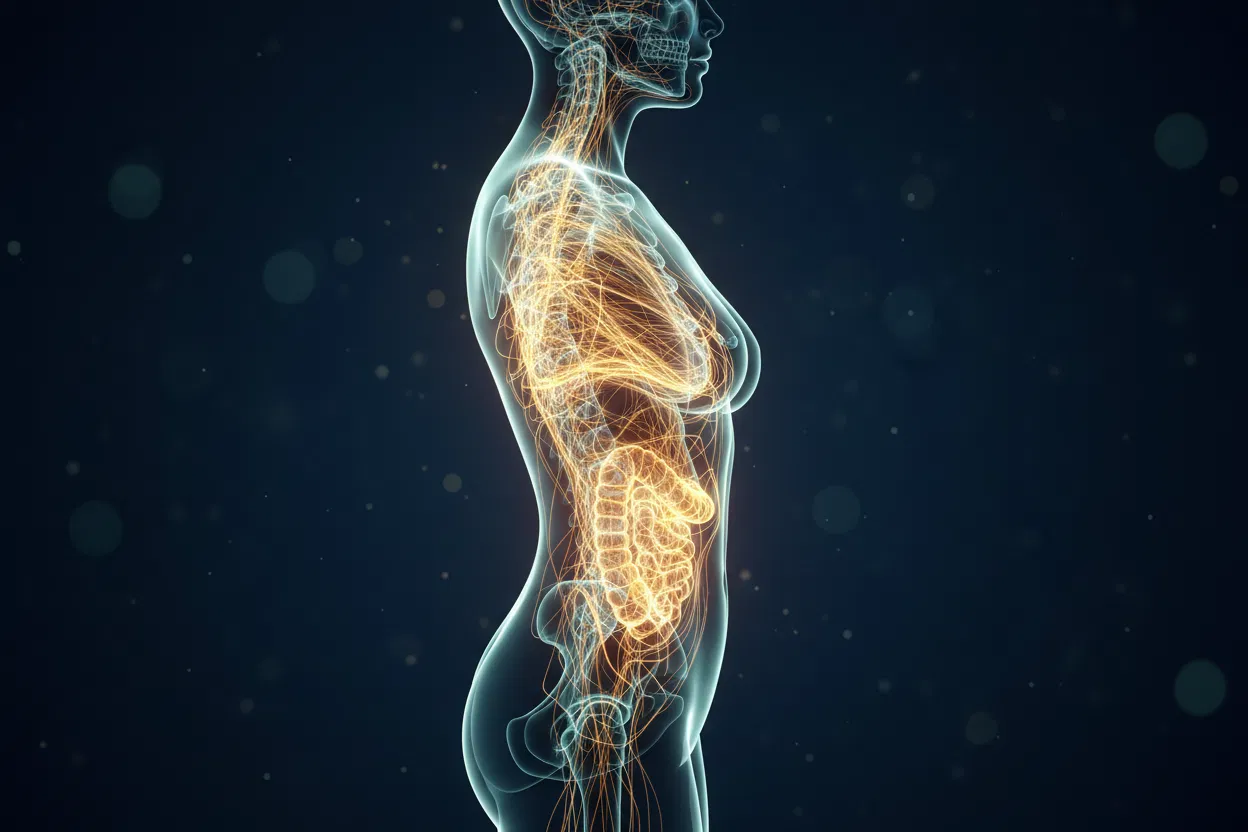
Hi everyone, I'm Dr. Ki. If you've been following my work, you know that one of my core beliefs is this: most chronic illness isn't a collection of unrelated problems. It's a single pattern, expressing itself through whichever doors your body happens to open first.
I see it every week in clinic. A patient walks in carrying seven medications from six different specialists — one for migraines, one for anxiety, one for sleep, one for joint pain, one for chest palpitations, one for the gut, one for blood pressure. Each pill is targeting a leaf on the tree. None of them are looking at the root.
In Traditional Chinese Medicine, the teaching is simple: emotional and spiritual trauma stuck in the body causes disease. In modern language, we'd say chronic stress and a dysregulated nervous system are the soil from which most chronic conditions grow.
So when patients ask me, "Dr. Ki, what do I actually do?" — I don't hand them another prescription. I walk them through a framework I've spent years building, both as a rheumatologist and as someone who lived with chronic pain for 15 years before finding my own way out.
I call it The Three Alignments.
You Are a Car
Before we get into the three pillars, let me give you the mental model I share with my patients. Imagine your body is a car. To drive well, three systems have to be in alignment:
The Chassis
The physical structure that carries you down the road.
The Fuel
What you put into the tank — food, water, nutrients.
The Driver
The consciousness behind the wheel — your thoughts and emotions.
If your chassis is bent, even premium fuel and a calm driver won't save you. If your fuel is contaminated, the cleanest chassis will sputter. And if the driver is panicking at every shadow on the road, the whole vehicle suffers — no matter how perfect the rest.
Most patients I see have all three out of alignment. That's actually good news. It means there are three places to start.
Pillar 1: Physical Alignment
When a new patient walks into my office, the first thing I do is look at their feet, hips, and shoulders. Why feet? Because your body has a center of gravity, and from the side, your ankle, knee, hip, shoulder, and head should stack in a straight vertical line. Both shoulders should sit at the same height. Both hips, too.
In years of practice, I have met exactly two perfectly aligned bodies. One was a gymnast. The other was a ballerina. Everyone else? Asymmetry. One foot is flatter. One leg bows. One shoulder rides an inch lower. One hip tilts.
Your brain doesn't actually care about any of this. Its only job is to keep your two eyes level with the horizon. So when you sprain an ankle, your knee compensates. Then your hip. Then your low back. Then your upper back. Then your neck. And eventually you're sitting in my office with migraines and exhaustion, wondering where it all came from.
Sitting Is a Sport
Modern life makes the alignment problem worse in two specific ways. The first is sitting. The psoas muscle runs from your lower spine down to your thigh, and its job is to lift your leg when you walk. When you sit for eight hours a day, that muscle gets locked in a shortened position and pulls relentlessly on your low back.
The second is screens. Your shoulders roll forward. Your head drifts in front of your spine. When the head drifts forward, the effective load on the neck can increase by as much as 75%. That's not a metaphor — it's basic physics.
Stress Tightens the Frame
On top of the postural problem, stress adds a second layer. When you're in fight-or-flight, your muscles tense to prepare for action. The fascia — the connective tissue web that wraps every muscle and organ — tightens with them. Blood flow narrows. Lymphatic drainage slows. Energy doesn't flow.
The fix is layered:
- Osteopathic and acupuncture work to release stuck fascia and reset alignment.
- Physical therapy to retrain the muscles holding the new pattern.
- Daily movement — yoga, Tai Chi, or simply walking — to keep what you've earned. For my patients over 70, I almost always recommend Tai Chi as their daily practice.
You don't have to fix everything in a week. You just have to stop driving on a flat tire.
Pillar 2: Nutritional Alignment
Tony Robbins teaches that complexity is the enemy of execution. Nowhere is that more true than in nutrition. Pick up any book on the anti-inflammatory diet, the Mediterranean diet, the DASH diet, or the autoimmune protocol. They argue about details, but they agree on one thing: eat mostly plants.
In 2023, the American College of Rheumatology released integrative treatment guidelines recommending the Mediterranean diet for rheumatoid arthritis. That's a meaningful shift in mainstream rheumatology — and one I've watched my own patients benefit from for years.
Here's the simplest version I give patients. Imagine your plate as a circle:
70%
Colorful Vegetables
The main event, not the side dish.
15%
Clean Protein
Fatty fish, legumes. Limit red meat.
15%
Complex Starch
Rice, sweet potato, whole grains — in reasonable portions.
A few non-negotiables I've watched make a real difference:
- 60–80 ounces of water a day. Your fascia is mostly collagen and water — it needs hydration to glide.
- Remove refined sugar. A single bottled orange juice can carry over 20 grams of added sugar. Sugar is rocket fuel for inflammation.
- Cut ultra-processed foods. If your great-grandmother wouldn't recognize it as food, your immune system probably doesn't either.
"There's also a quieter principle here that matters to me. Foods carry energy. A vegetable pulled from soil last week and a snack synthesized in a factory in 2019 are not equivalent inputs into a living system. Eating clean isn't only about macronutrients. You're choosing what frequency you want your body to vibrate with."
Pillar 3: Emotional Alignment
This is the pillar I'm most passionate about, because it's the one most often missed — and the one that finally moved the needle for me personally.
Here's a study I think about constantly. In identical twins, where one twin develops lupus, the chance the other twin also develops lupus is less than 30%. Same DNA. Same parents. Often the same childhood home. And yet the disease shows up in one and not the other. What's the difference? Not the genes. The meaning each twin gave to the events of their life.
Tony Robbins teaches that life happens for us, not to us. Dr. Joe Dispenza teaches that the most important practice you can develop is having a different thought in the exact same situation. These aren't motivational slogans. They're descriptions of how the nervous system actually rewires.
Same Trigger, Different Response
Neurons that fire together, wire together. This is called Hebbian learning. Every time a stressful situation triggers the same fearful reaction, you're strengthening that pathway. You are practicing fear — and your brain, being a learning machine, is getting better at it.
In chronic pain patients, this isn't theoretical. Brain imaging shows real structural changes in regions like the default mode network, the insula, the amygdala, and the hippocampus. The brain literally becomes better at producing pain. The reverse is also true. Every time you pause before reacting — every time you choose a different thought — you're laying down a new track. Slowly, the old one weakens. This is the work.
Pause, What a Pleasure
"In Kabbalah, there's a teaching: Pause, what a pleasure. In that small gap between trigger and response is where every meaningful choice in your life is made. It's where you decide who you are becoming. I think of it like Mario Kart — you don't always control what shows up on the track. You control which way you turn."
Practical Tools
You don't have to start with an hour of silent meditation. Some of the most useful tools I give patients are small:
- A 15-minute morning meditation — even just sitting with your breath.
- Heart Rate Variability (HRV) tracking — a simple way to see whether your nervous system is actually recovering.
- Body-based work — yoga, tapping (EFT), breathwork. The body has to feel safe before the mind can be reasoned with.
- Loving community. People do not heal in isolation. They heal in relationship — sitting next to someone in a yoga class, breathing in sync, sharing a meal.
Why All Three Matter
Patients sometimes ask me, "Can I just pick one?" You can start with one. You should start with one. But here's the truth: challenge will keep coming. That's the nature of being alive. If your chassis is straight but your driver is panicking, you'll still crash. If your meditation practice is deep but you're eating inflammatory food and sitting hunched 10 hours a day, your body will keep sending up flares.
The three alignments work together because the body is one system. The fascia carries emotion. The food becomes the tissue. The thought changes the breath. There is no clean line between physical and emotional, between nutrition and consciousness. You are working on one being from three angles.
Where to Begin
Traditional Chinese Medicine has a saying I love: Where there is flow, there is health. Where there is blockage, there is disease.
So my invitation is the same one I leave my patients with at the end of every visit:
Pick one thing this week.
One walk. One meal that's 70% plants. One five-minute pause before responding to a difficult email. You don't have to overhaul your life. You just have to start telling your nervous system, in small ways, that it is safe to soften.
Healing begins the moment the body stops bracing.
Share this article